

Have you ever caught yourself tapping your feet to a catchy tune or humming your favorite song on a gloomy day? It's amazing how music can transform our mood and uplift our spirits in an instant!

And did you know that the secret behind many cheerful melodies lies in the major scale? It's one of the most widely used scales in music, and the best part is you don't even need to be a music expert to recognize it.
In this article, you'll learn how major scales are constructed, how to identify them using their formula, the modes of a major scale, and how to use major scales in music composition.
Let’s dive in!
What is a Major Scale?
The major scale is a group of seven notes organized in a unique interval pattern, forming a sound familiar to all major scales. But how do we find which notes belong to which major scale? We need to start from the basics to fully understand the logic behind a major scale.

As you know, there are twelve notes in Western music. The most straightforward way to look at notes is on the white and black keys of the piano. The first seven letters of the alphabet (A to G) are assigned to the white keys. The black keys are relative to the white keys but add 'sharp' and 'flat' to their names. Sharp and flat refer to a note being a lower (flat) or a higher (sharp) tone. They’re also indicated with a 'b' for flat and '#' for sharp.
So, the twelve notes are A, A#/Bb, B, C, C#/Db, D, D#/Eb, E, F, F#/Gb, G, G#/Ab. As you see, the same note can have two names: sharp or flats. When to use each one will depend on the musical key you are on. One of the rules when writing a major scale is that every note name can appear only once, and you cannot skip letters. You will use sharps and flats to avoid skipping or repeating letters.
Remember the definition of a major scale: "a group of seven notes organized in an interval pattern." Music scales have patterns that define the type of scales. These patterns are formed in intervals of whole steps (W) and half steps (H).
The distance between each of the twelve notes is a half-step. For example, from A to A#/Bb is one half step of distance, and the same for B to C. Whole steps equal two half steps of distance. So, a whole step from A is B, and the same goes for C to D.
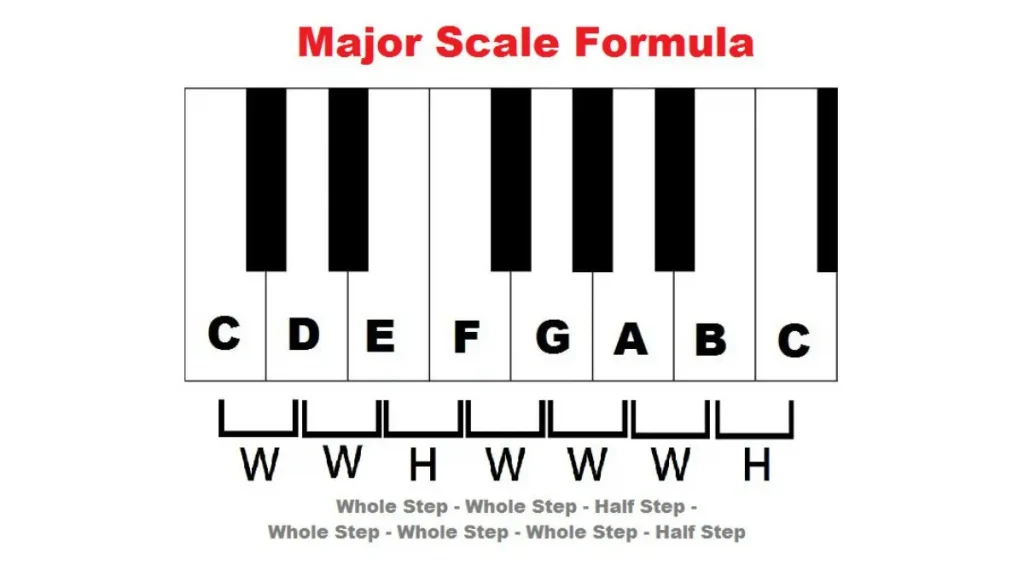
Now that you know what whole and half steps are, you can understand the major scale pattern defined by the formula W-W-H-W-W-W-H. Where W means a whole step and H a half step. If you remember or memorize this formula, you can write and play any major scale.
All major scales have a root note. It's the first note of the scale and the note that gives its name. If you want to play the C major scale, your root note is C. If you're playing the E major scale, your root note is E. Then, you follow the formula to find the seven notes after the root note in that major scale. Another of the rules of the major scale is that it starts and ends on the same note. Major scales will consist of eight notes because you repeat the first note at the end but an octave higher.
An octave is the distance between the same note lower or higher. Again, looking at the piano, play the C note, then count the twelve notes until you reach the C note again. That distance between both C notes is called an octave and comprises twelve half steps.
You might not know which key it is when you listen to a song, especially since all major scales sound similar. So, it's important to understand how to write major scales to identify them. Luckily, professional tools like Auto-Key 2 can help you automatically detect the key, scale, and even the tempo of a piece of music. However, you still need to know how those notes work together in the scale!

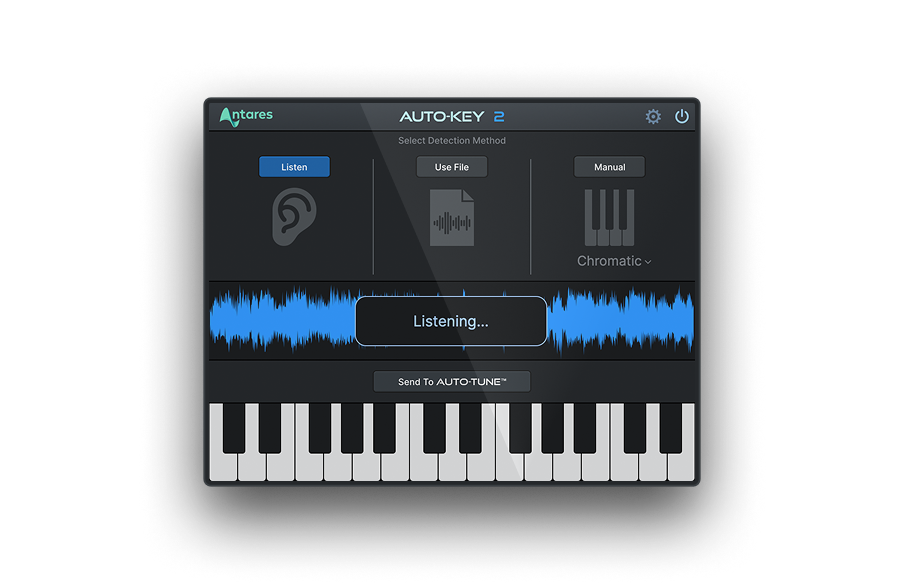
AutoKey
Automatic Key, Scale, and Tempo Detection
Before we jump into some examples and exercises in major scales, there's one thing I want to add. The term diatonic scales is often used interchangeably with major scales, and while a major scale is a diatonic scale, these come in different patterns. Diatonic scales are seven-note scales with five whole steps and two half steps in their pattern, where two or three whole steps separate the half steps.
If you think of the major scale pattern W-W-H-W-W-W-H, it meets the requirements to be a diatonic scale. You'll see more about diatonic scales when you get to the modes of the major scale, but for now, the best way to reinforce all we've discussed about major scales is with some examples.
C Major Scale

Let's review all you've learned about major scales by breaking down one of the easiest ones to understand: The C major scale. If you need to remember the formula, the C major scale is the perfect example to memorize the scale's structure.
Remember our twelve notes: A, A#/Bb, B, C, C#/Db, D, D#/Eb, E, F, F#/Gb, G, G#/Ab. And the major scale formula: W-W-H-W-W-W-H. You can follow this example using pen and paper, a music notation sheet, or your instrument.
If it's easier for you, you can have the 12 notes written with the major scale formula to use as a reference.
Major Scale Reference Table
| 12 Notes | A, A#/Bb, B, C, C#/Db, D, D#/Eb, E, F, F#/Gb, G, G#/Ab |
| Major scale formula | W-W-H-W-W-W-H |
Write your root note C. Look at the twelve notes and start counting steps following the formula. Remember, you jump two notes with a whole step, and a half step is just one. You start and end in the root note again. If you don't end in C, something went wrong in the middle.
Below, you'll see how I used a different color in the skipped notes and only left the ones that belong to the scale. You'll see that the C major scale includes the notes C-D-E-F-G-A-B-C with no flats or sharps.
C Major Scale Breakdown
| Counting from root | R 1 2 1 2 1 1 2 1 2 1 2 1 |
| Notes | C, |
| Formula | W W H W W W H |
| C Major Scale | C - D - E - F - G - A - B - C |
A Major Scale

Let’s repeat the exercise with the A major scale. Start with A as your root key and follow the major scale formula.
A Major Scale Breakdown
| Counting from root | R 1 2 1 2 1 1 2 1 2 1 2 1 |
| Notes | A, |
| Formula | W W H W W W H |
| A Major Scale | A - B - C# - D - E - F# - G# - A |
Remember I mentioned how it depends on the key if we use sharps of flats? You may wonder why I used sharps instead of flats in A major. If you wrote the A major scale as A, B, Db, D, E, Gb, Ab, and A, you'd skip C and F and repeat D and A. Remember that you can't skip or repeat letters.
B Major Scale

The B major scale is another good example of when to use sharp or flats. Write the root note B and follow the formula. We don't use flats in this scale because it will look like this: B, Db, Eb, E, Gb, Ab, Bb, and B, and we can't skip or repeat.
B Major Scale Breakdown
| Counting from root | R 1 2 1 2 1 1 2 1 2 1 2 1 |
| Notes | B, |
| Formula | W W H W W W H |
| B Major Scale | B - C# - D# - E - F# - G# - A# - B |
Modes of the Major Scale
Now, it's time to dive into the major scale modes. Each note in the major scale is a degree of the scale related to the root note. In total, you can find seven degrees on a major scale. Let's continue using the C major scale since you already know it.
- C – 1st degree
- D – 2nd degree
- E – 3rd degree
- F – 4th degree
- G – 5th degree
- A – 6th degree
- B – 7th degree
If you start the scale at a different degree, you'll play the major scale in a different mode. The order of the notes remains the same, but the pattern changes. For example, the C major scale starts in the first degree of the scale, which is also called the Ionian mode.
If you start the C major scale on the second degree, the scale would be written D-E-F-G-A-B-C-D, also called the Dorian mode.
If you start the C major scale in each degree, you'll find the seven modes of the C major scale. You can do these with all major scales.
Summary of the Modes in the C Major Scale
| Mode | Degree | Pattern | Example with C Major |
| Ionian | First | W-W-H-W-W-W-H | C-D-E-F-G-A-B-C |
| Dorian | Second | W-H-W-W-W-H-W | D-E-F-G-A-B-C-D |
| Phrygian | Third | H-W-W-W-H-W-W | E-F-G-A-B-C-D-E |
| Lydian | Fourth | W-W-W-H-W-W-H | F-G-A-B-C-D-E-F |
| Mixolydian | Fifth | W-W-H-W-W-H-W | G-A-B-C-D-E-F-G |
| Aeolian | Sixth | W-H-W-W-H-W-W | A-B-C-D-E-F-G-A |
| Locrian | Seventh | H-W-W-H-W-W-W | B-C-D-E-F-G-A-B |
If you notice the pattern changes, it still maintains the order of the notes, and you have two and three whole steps between the half notes, which makes these scales modes diatonic scales. The sixth degree of a major scale, the Aeolian mode, is its relative minor scale. But that's for another day.
By knowing the C major scale only, you have seven scales at your disposal that you can start using for practicing or composing music.
Application in Music
Major scales are widely used in music composition. For example, chords are made of notes within the same scale. A basic form of a chord consists of triads, playing the root, third degree, and fifth degree of the scale. In C major, that would be the notes C, E, and G, which form the C major chord. Learn more about chords in our Major Chords article.

You can find major scales in popular music and classical music. Here are some examples of songs that use major scales.
- Pachelbel's Canon in D uses D major.
- Mozart’s Piano Sonata No. 16 uses C major.
- Don’t Stop HYPERLINK "’ by Journey uses E major.
- Dancing Queen by ABBA uses A Major.
Notice how they all have a common feeling of happiness and joy with a bright sound overall. They make you want to get up and dance! The major scale is common in classical and jazz music but can also be found in rock and pop music.
Some compositions are not entirely based on a major key but combine other keys to create a unique mood. A common use is songs starting in a major key and then changing to minor in the chorus, bridge, or only the final chorus to evoke a contrasting feeling.
Conclusion
By learning how major scales are built, you'll gain a deeper understanding of why music sounds the way it does and have powerful tools at your fingertips for songwriting and composition. Don't forget the formula W-W-H-W-W-W-H, the twelve notes, and how to label the degrees – armed with this knowledge, you can create any major scale in any of its seven modes. So what are you waiting for? Get out there and start experimenting with creating melodies using the major scale!
Glossary
Root: A root note is the first note in a scale that establishes the tonality of the key.
Octave: Is the distance between two notes with the same name. In this interval, the notes can have twice the frequency (a higher octave) or half its frequency (an octave lower).
Half Step: This is the minimum distance between the notes, also called a semitone. All twelve notes in Western music are separated by one semitone or a half step.
Whole Step: A whole step equals two half steps and is also called a whole tone or tone.
Diatonic Scale: It's a heptatonic scale (seven-note scale) organized in a pattern of five whole steps and two half steps where the half steps must be between two or three whole steps as in the major scale pattern W-W-H-W-W-W-H

AutoTune Unlimited
The Ultimate Vocal Production Suite

Exclusive AutoTune Content

AutoKey

AutoTune Unlimited

AutoTune 2026 and Metamorph
Now Included

Antares Editorial
Antares is a leading developer of software for music recording and live performance. For over 20 years, Antares has powered the music of top-charting and indie artists with products including the industry standard for pitch correction, AutoTune™.