
One of the most exciting parts of any musician's career is finally getting paid from doing the thing you love most, making music. Once you start bringing in some income, it’s important to know that songwriting royalties are split into 4 different types, performance, mechanical, sync and print. The catch is none of them pay automatically, and every stream, every radio spin, every sync placement generates money that exists in a system waiting for you to claim it. Most beginners never set that up, which means plenty of writers are quietly owed money right now and don't know it. This guide breaks down each royalty type, who collects it on your behalf and exactly what you need to do to start seeing it.
First, Understand This: Every Song Has Two Copyrights
When you write a song and record it, you've created two separate pieces of intellectual property. They get paid differently and tracked separately.
- The composition is the song itself, the melody and the lyrics. If you wrote it, you own this copyright, and money earned on the composition is publishing income.
- The master is the specific recording of that song. Whoever paid for the recording session usually owns this, and money earned on the master is recording income.
If someone covers your song, you both get paid, you on the composition, them on their recording. Two copyrights, two income streams, both running in parallel for the life of the song.
Songwriters live on the publishing side while every royalty type below sits on that side of the line.
The Four Royalties That Pay Songwriters
Each kind of royalty comes from a different kind of song usage, they get collected by a different organization, and land in your account on its own timeline.
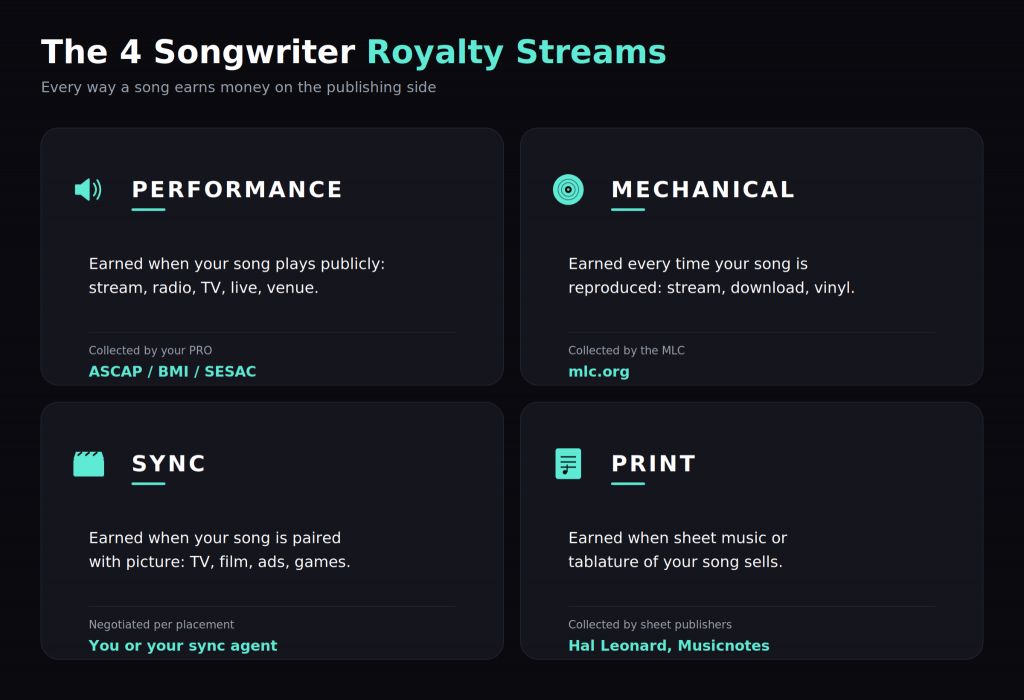
1. Performance Royalties
You earn these every time your song reaches the public, whether streamed on Spotify, played on the radio, used on TV, performed live at a venue or piped through a Starbucks ceiling speaker. Anywhere a song reaches an audience that isn't your living room, you've earned a performance royalty.
A Performing Rights Organization (PRO) collects these on your behalf. In the US, you've got three options:
- ASCAP. Nonprofit. $50 one-time fee for songwriters. Open enrollment.
- BMI. For-profit. Free for songwriters. Open enrollment.
- SESAC. For-profit. Invitation only. They find you once you're charting.
You can only belong to one PRO at a time. For most beginning songwriters, the practical difference between ASCAP and BMI is small. Pick one, register your songs and the money starts flowing. If you skip this step, every public play of your song earns you exactly zero dollars.
2. Mechanical Royalties
These get triggered when someone reproduces your song. That used to mean pressing a CD or stamping a vinyl record (the "mechanical" reproduction of the song onto a physical format, which is where the name comes from), but today it also covers digital downloads and every on-demand stream.
For physical formats and downloads in 2026, the statutory mechanical rate sits at 13.1 cents per song sold, or 2.52 cents per minute for songs over five minutes. Sell 1,000 vinyl copies of a 10-track album you wrote and the songwriter side owes you 13.1¢ × 10 × 1,000 = $1,310 before any splits.
For streams, mechanicals get paid through the Mechanical Licensing Collective (MLC), a nonprofit set up by the Music Modernization Act in 2018. Their job is to track every interactive stream of every song and route the mechanical share to the right writer.
If you have music on Spotify, Apple Music, Tidal or Amazon Music and you've never set up an MLC account, mechanicals are piling up that nobody is claiming. Registration is free at mlc.org. Plus, it only takes about 20 minutes.
3. Sync Royalties
Anytime your song gets paired with picture, that's a sync. TV shows, films, video games, commercials, YouTube ads, TikTok branded content all require the licensee to pay an upfront fee for the right to use the song, and the song also generates performance royalties downstream when the show or ad airs.
Sync fees range from a few hundred bucks for an indie YouTube spot to six figures for a Super Bowl placement with no fixed rate. Each deal is negotiated per placement, per usage, per duration.
This is the single most lucrative one-off opportunity most songwriters will ever land. One needle drop on Grey's Anatomy has paid more than years of streaming income for plenty of indie writers. If you want to get your songs in front of music supervisors, our sync licensing guide walks you through the full pitch process.
4. Print Royalties
Sheet music and tablature sales make up a smaller slice of the pie for most modern writers, but if your song gets transcribed and sold through Hal Leonard or Musicnotes, you collect on every copy. Classical, jazz, worship and educational arrangements are where print still moves real money. For streaming-era pop and hip-hop writers, it's a rounding error, but one worth registering for since it costs nothing.
Where Does Your Streaming Payout Actually Go?
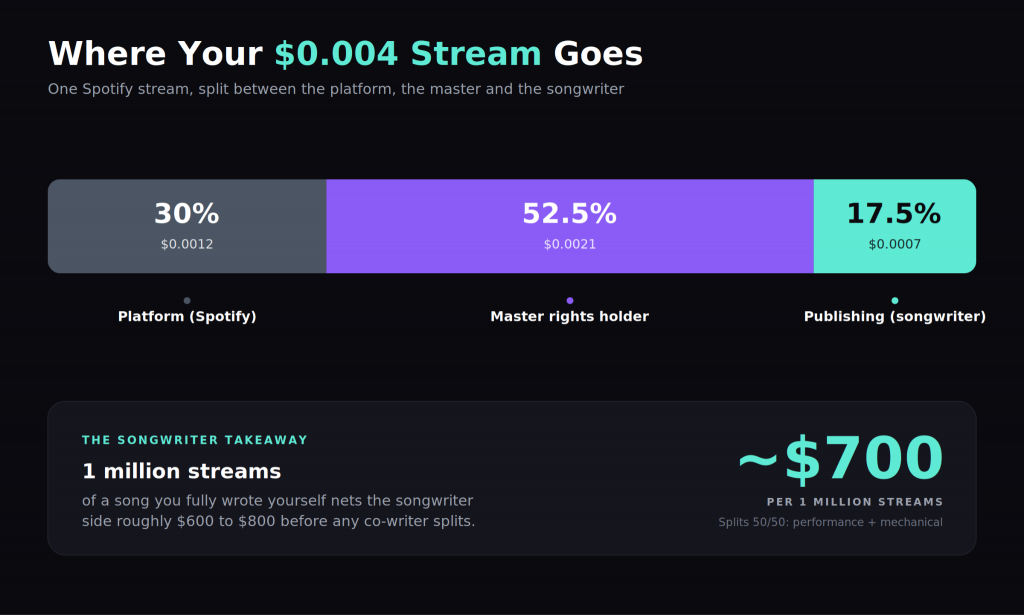
The number thrown around for Spotify is roughly $0.003 to $0.005 per stream. Call it $0.004 on average. That's the gross amount paid out per stream across all rights holders, not what the songwriter sees.
Here's how a single stream gets sliced:
| Recipient | Rough Share |
| Spotify (platform) | 30% |
| Master rights holder (label or independent artist) | 50-55% |
| Publishing (songwriter + publisher combined) | 15-20% |
Out of that $0.004 stream, the publishing side gets about $0.0006 to $0.0008. That publishing payment then splits between the mechanical share (paid via the MLC) and the performance share (paid via your PRO). If you wrote the song alone with no publisher in the middle, you collect all of it, if you co-wrote with two other people then you get a third.
One million streams of a song you fully wrote yourself nets the songwriter side somewhere around $600 to $800. That math is why working songwriters stack income: streams plus sync plus live plus direct-to-fan support.
How to Start Collecting in Five Steps
You can do all of this in one focused afternoon.
- Join a PRO. ASCAP or BMI is the best place to start for most people. Register as both a writer AND a publisher (you can self-publish at the start to keep 100% of your performance income). The whole process takes about 15 minutes online.
- Register with the MLC. Free, at mlc.org. Unlocks every mechanical royalty from streaming services going forward and lets you claim a slice of unclaimed historical royalties if your work qualifies.
- Register every song you write. With both your PRO and the MLC. Do this at release, not "someday." Unregistered songs don't get matched, and unmatched royalties sit in a black box that may never reach you.
- Get your music to streaming services. A distributor like DistroKid, TuneCore or CD Baby uploads your music to Spotify, Apple Music and every other platform. If you don't know how to set this up, start with our music distribution guide.
- Consider a publishing admin. Companies like Songtrust, Sentric or Kobalt's Awal will register your songs globally, chase down international royalties and pitch your catalog for sync. They take 10-20% of what they collect. For songwriters with international streams, the foreign performance royalties they recover usually pay for the cut.
What Mistakes Are Leaving Songwriters Unpaid?
Not registering as a publisher. When you join a PRO as a songwriter only, you're collecting exactly half the performance royalty. The other half, the publisher's share, sits unclaimed. Nobody sends you a notice. It just doesn't arrive. Register as a self-publisher when you join and you keep the whole thing.
Skipping the MLC. Every stream of every song you've ever released is generating a mechanical royalty. If you haven't set up your MLC account, that money isn't going to you, it's sitting in a pool that eventually gets redistributed to other writers based on market share. It's free to register and takes 20 minutes. There's no good reason to wait.
Not putting co-write splits in writing. You finish a song with someone on a Tuesday afternoon, it gets placed in a show two years later and now nobody can agree on who owns what. Split sheets feel unnecessary until they suddenly aren't. Sign one the day the song is done, every time, no exceptions.
Releasing music with wrong or missing metadata. Your songwriter name, your PRO affiliation and your IPI/CAE number need to be embedded in the metadata that goes to streaming platforms. If any of it is missing or misspelled, the royalty payments get generated and then have nowhere to go. They don't bounce back to you, they just disappear into the matching gap.
Never pitching for sync. Music supervisors are actively looking for songs that major labels can't afford to clear. If you've never submitted your catalog anywhere, you haven't missed out, you just haven't started yet. One placement can outpay years of streaming income overnight.
Every royalty stream above only kicks in when you have a finished, released song because those half-written demos sitting on your hard drive earn nothing.
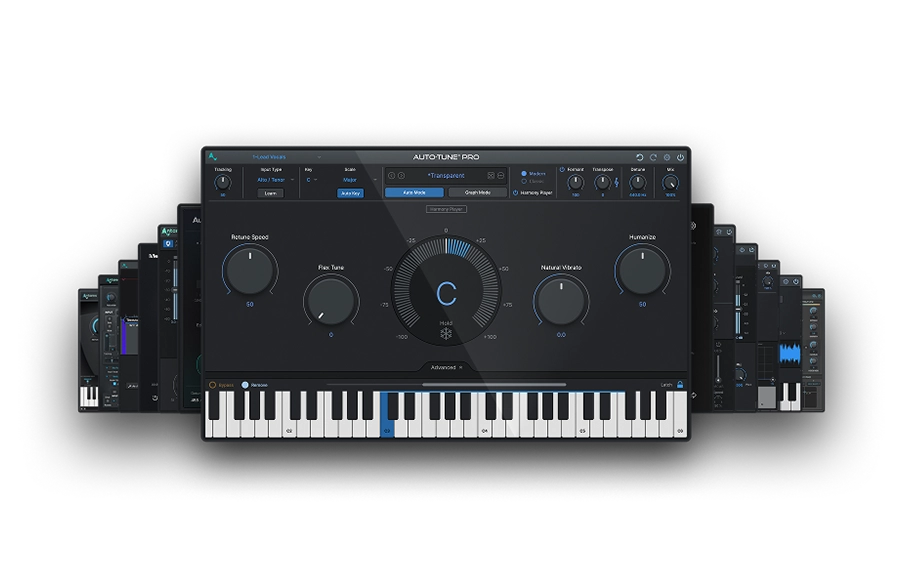
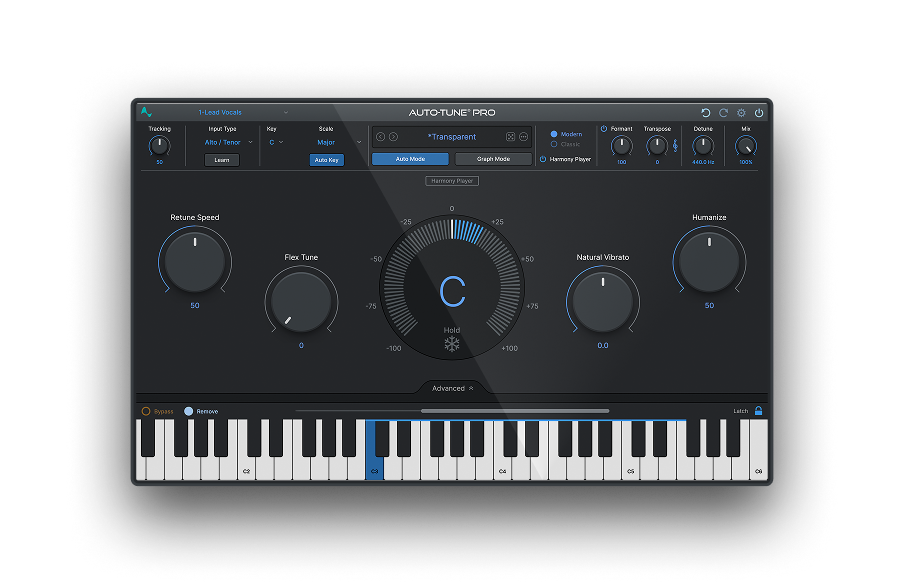
AutoTune Unlimited gives you the full vocal toolkit on subscription giving you pitch correction with AutoTune Pro 11, the AI-Powered Vocal Chain for a professional sound and vocal effects like Harmony Engine that helps take a rough write into a release-ready master. If the bottleneck between you and royalty income is finishing songs, start there. Have fun, and go make your next hit!

AutoTune Unlimited
The Ultimate Vocal Production Suite
Frequently Asked Questions
How much do songwriters make per stream?
The songwriter share of a Spotify stream lands around $0.0006 to $0.0008, depending on whether the listener is a Premium subscriber and what country they're in. That payment splits between mechanical (via the MLC) and performance (via your PRO). One million streams pays the songwriter side roughly $600 to $800.
Do songwriters make more than performing artists?
It depends on the deal. Performing artists collect on the master recording, which is the bigger share of streaming revenue. Songwriters collect forever, on every cover and every public performance, with no producer or label splits eating the publishing side. Long-term, songwriting income is more durable. Performing artists usually earn more upfront on a hit release.
Can you make a living as a songwriter?
Yes, but the math is brutal at streaming-only scale. Most working songwriters stack income from multiple sources: a publishing deal or admin advance, sync placements, co-writes for major artists and sometimes their own performing career. Sync placements and cuts on major releases are the fastest paths to full-time songwriter income.
What's the difference between a songwriter and a publisher?
The songwriter writes the song. The publisher administers it: registers it with collection societies, pitches it for sync, audits royalty statements and chases down unpaid royalties globally. By default, every songwriter is also their own publisher. Signing with a traditional publisher means giving up a percentage of publishing income in exchange for catalog work, advance money and industry relationships.
Do I need a publisher to get paid?
No. You can self-publish, register directly with both your PRO and the MLC, then collect every dollar yourself. A publisher or admin company speeds up the process, especially for international royalties, but it's not required to start collecting.

Exclusive AutoTune Content

AutoTune Pro

AutoTune Unlimited
AutoTune 2026 and Metamorph
Now Included

Antares Editorial
Antares is a leading developer of software for music recording and live performance. For over 20 years, Antares has powered the music of top-charting and indie artists with products including the industry standard for pitch correction, AutoTune™.